What Is a Pagan?
Musing on the superficial nature of language hits hard when you’re a suicidally in love 15-year-old.
After all, “What's in a name? that which we call a rose / By any other name would smell as sweet”
It loses its edge when you fathom the consequences of categories. Words, as women have collectively realized, matter. They matter because, without clarity on what a woman is, now millions of females must endure stubbly, sausage-endowed “women” in their showers and pummeling them in the boxing ring.
Getting words wrong not only has real political consequences, but it also shapes how we see the world, how we work the magic of words to shape the visions of others, and how abstractions flow out and ossify into matter.
When practitioners ask, “What is a pagan?” they typically assume that there is a single answer—and their fumbling around, talking past one another, arguing in circles, and poorly placed arguments too often fall flat as a result of this clumsy handling of the issue. There isn’t a single answer. The term functions in three ways: as a standard of what should be (prescriptive), as a record of how groups actually use the word (consensual), and as a technical category meant to describe religious groups with precision (taxonomic).
Confusion arises because these modes bleed into one another. Moral exhortation masquerades as description; folk usage pretends to be scholarship; and scholarship is often little more than exhortations couched in references. The result is a lot of noise, misunderstanding, and poorly conceived ideas.
This essay disentangles the three meanings, shows how each operates, and explains why pagans who fail to recognize the distinction end up wasting so much breath.
The Prescriptive: This is what a pagan should do
The first sense is the meaning you’ll encounter 95% of the time among pagans. When we say a “pagan is…”, “a pagan believes…”, or “a pagan practices…”, we rarely describe all pagans. Rather, we are describing what a good and true pagan ought to do within the narrow confines of our particular beliefs.
When Hammer and Vajra states that “a pagan exercises, worships the gods and ancestors, studies the sages, and creates a legacy of blood,” his exhortation is not directed at all pagans. He is not demanding the septum-pierced witch who jars her menses, frets about the pesticides in her spiced-pumpkin latte, and tags #nooneisillegalonstolenlan to start doing squats three days a week. That might be good advice, but she is not the subject of his ass-kicking.
Rather, he is targeting the narrow bandwidth of reactionary, sensitive young men who have gathered around his channels. The septum-pierced they/them would be told to scutter off to their next medical appointment. The exclusivity adds to its zing. The subtext of the Tweet is: “You’re not like that loser. You’re a REAL pagan—and a REAL pagan murders weakness!” With that single word, packed with meaning, with aspirations, with icons and tales of Coo Chulainn slaying a host of heroes, infused with the gods themselves—pagan—he draws a line in the sand: US/THEM and pushes his viewers towards the US side.
Hammer and Vajra’s writing would lose its punch if he wrote out the verbose but technically correct form of address: “A reactionary Traditionalist pagan, heavily influenced by Vajrayana and the ascetic, animistic traditions of Japan, must squat weekly!” The description might be more precise, but it is also dead-on-arrival. Anatomical illustrations accurately depict the human form, but when a horny young man seeks the titillations of the flesh, he doesn’t open an anatomy book. He wants titties. “Pagan” is the religious form of titties, condensing all those precise technical details down into a single sexy word that would launch a thousand ships.
The rhetorical flourish and tribal marking often lead to confusion—particularly among pagans with radically different visions of the religion. The prescriptive, used effusively by priests, standard bearers of the faith, and schoolmarms, bleeds into the descriptive. Thus, 17th-century Dutch missionaries turned themselves blue explaining to Japanese daimyo that, despite being 98% similar, the Spanish Catholics are not Christians and deserve to have their hearts cut out and their corpses tossed into the sea. This did not go very far, and whatever political gains they accrued were won through more pragmatic considerations.
A similar phenomenon occurs among pagans—often with some cringe-worthy statements that pander to the stupidest of the stupid.
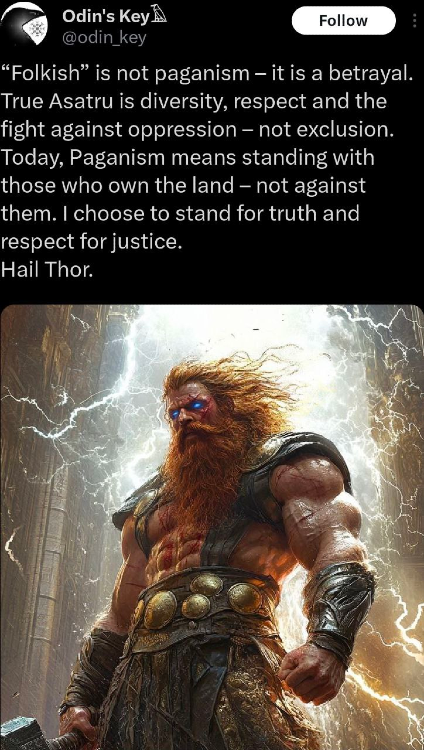
As a right-wing degenerate who worships Kek, my opinions and his differ. Putting aside our 21st century disputes, the above statement is false—unless the author claims that the Vikings, who went around ransacking churches, raping women, stealing land, and so terrorizing the French that the king gave them a fat piece of coastal territory and the hand of his daughter just to get them out of his hair, were actually non-violent, peace-loving social justice warriors. That line seems a bit of a stretch.
The author is not that ignorant. What he is actually doing with this post is circumscribing the borders of his worldview and projecting them onto the modern pagan community as a whole. “We inclusive heathens are good and true—and those outside of this circle are evil, wrong, and unfit to be called a pagan!” It is hysterical and stupid, but it is what it is.
This rhetoric infuriates many on the right, and understandably so, but what else would you call this person who earnestly worships Thor and Odin? Who studies the history of their ancestors? Who revives and preserves some of their ancient customs? Who performs regular blots and recants the tales of the old gods? If not a pagan, then what? A commie retard might get you fist bumps by the bros, but it is not consistent or sensible when trying to outline the contours of religious beliefs and groups.
Like it or not, they’re a pagan.
The confusion and outrage follow from the insular and prescriptive character of pagan discourse. While discussing among friends over beers, while snapping the whip at “RETARDS” and “FAKES” online, while chatting in private Telegram groups, and even in quiet moments of reflection as they mull over “the pagan” approach to technology or fitness, the prescriptive frame has nearly blinded them from categorical precision. The heuristic quietly replaces the real, and then, they end up swiping at phantoms and mistaking rhetoric for reality.
The prescriptive frame, even in private contemplation, is not wrong. It is, in fact, necessary. Odin’s Key can bloviate all day about what a “TRUE” pagan is—so long as he and his readers recognize that the TRUE pagan is shorthand for their own niche constellation of views and values and is not applicable to the religion as a whole. They—and we—err when the prescriptive obscures the factual.
The Consensual: How a group describes a pagan
Language’s primary function is to efficiently condense, store, & convey information. Storage is back-end, conveyance front, while condensation is shared equally between the two. While computer data is stored in binary code, humans have encoded everything from aurochs to Democracy in sounds and letters.
The words selected are somewhat irrelevant to their meaning. A dog could just as easily be called inu (Japanese) or koira (Finnish). The main reason dog means dog is that we have collectively agreed upon it. Prior to the 14th century, hound was the general term while dog referred to powerful mastiffs. Usage changed (in this case, due to Norman rule and the prominence of French) and the meaning of the term along with it.
The tricky aspect of language is that the encoded information remains invisible to its users. Two people can say the same word, like “dog,” but associate and feel quite different things. A peasant in the 11th century, hearing the word “dog,” would envision an imposing mastiff dutifully guarding its owner’s hall. You might think of a laberdoodle down the street who aggressively nuzzles intruders.
Pagan follows the same principle in mainstream usage. A recent (and comical) example of this at work is the title of a Christian book, Pagan Threat: Confronting America’s Godless Uprising. The book was heavily processed via ghost writers, and its title was likely concocted in a meeting room, optimized to up the heart rate of hysterical Christian women and boost sales, but the fact that this drivel could pass attests to how language actually exists—namely, as a meme within groups.
Objectively, paganism is a polytheistic religion organized around a set of shared rituals and beliefs (a fuller definition will follow). The concept of godless paganism makes about as much sense as a battery-free cell phone with a battery, an atheist Muslim, or a fascist anarchist. It is comically stupid, but within Christianity, paganism is synonymous with the devil and wickedness, both of which are memes for godlessness. The definition and usage is confused—and a lesson in why taxonomical clarity leads to better thinking and better book titles, but the term has internal logic and works on a memetic level.
Paganism as godlessness and, by extension, falling prey to the devil, is how many Christians understand the term. You can curse it for its inaccuracies. You can break it down with rigorous arguments. You can butcher them with memes, but the likelihood of a 40-year-old cradle Catholic changing his lexicon because of a lecture or a Pepe GIF is next to nil. This is how they use and understand the term—and we must be aware of that fact, correctness be damned.
A Boomer grandma who hasn’t gone to church in 20 years will conjure up different associations when she hears the word pagan. It might evoke a sigh and a roll of the eyes, as she imagines another schoolmarm panicking about satan’s infiltration into American culture. It might call to mind ancient Greeks sacrificing a bull off the coast of the Aegean or the exquisite and effete features of Apollo immortalized in marble. She most certainly won’t be thinking of Marcus Follin exhorting men to reclaim their land and heritage or a bunch of outcasts performing blots in the forests of Alberta.
If you want to understand and be understood by the boomer grandma or the evangelical Christian, you have to learn their vocabulary. Simply beating them over the head with “correct” terms will do you little good.
The other element of vocabulary that borders on the consensual and taxonomic is political. The meme side of political debate, used to pillory opponents or excite allies, falls clearly on the consensual side, but when it comes to laws and regulations, definitions veer into the territory of taxonomy.
In the pagan revivals of the 17th and 18th centuries, belonging to the “pagan” category of weirdo could bring ostracism or execution upon a worshiper of Jupiter. Arguing that Stoicism is technically pantheistic materialism and, thus, closer to Christian theology than the polytheistic occultism of Alexander’s Zeus Ammon would hold no water in court. You would be doomed to the gallows or shunned from polite society.
The recent recognition of paganism as a legitimate religious movement has opened the way to increased funding and legal protections. The US military now provides pagan chaplains. Prisons allow pagan priests to enter, perform ceremonies, and tend to devotees. Temples can gain tax-exempt status as places of worship—instead of being burned to the ground and having their ashes pissed on. These are concrete, significant victories that have hinged on a consensus about what it means to be a pagan and whether it is a legitimate religion.
A rose might swell as sweet were it called by any other name, but that doesn’t mean much when it comes to public policy, law, funding, and all the other trappings of the modern state. Here, words are more important than scents.
The Taxonomic: How a scholar defines a pagan
This final sense of the term is the most and least important. Entertaining such abstract questions as “What is a pagan?” might seem a pointless jaunt into academic disputation, but it is nothing of the sort. Living well depends upon aligning concepts as closely as possible with truth.
Most of us could rapidly improve the quality of our lives if we did two things: 1) define what a true friend is and 2) properly sort our associates into friend/not-friend categories. For most, the definition of a friend is a hazy constellation of feelings, cliches, and painful experiences hardened into informal rules that boil down to “this person makes me feel good.” Such a definition is ruinous. It potentially surrenders the most essential element of human flourishing to the doldrums of merely hanging out.
What does “feeling good” mean? Do you count the terrible headache and the anxiety you feel about whether you got herpes from that hooker come Sunday morning as part of the “feel” equation? Do you account for the gradual degradation of spirit after months of running yourself into the ground with an incessant complainer—even if he makes you laugh with his caustic wit?
We need not produce a multi-volume book to clarify what we mean by a “good friend,” but so much of life hinges on these categories, which, too often, are vague phrases tossed around assuredly and executed with as much consistency and consciousness as the murkily understood term itself. Great men choose great friends, and they are clear about what a true friend entails. “Feeling good” doesn’t cut it.
Questions of religious grouping are also critical, for they instruct us on how to relate to different groups, how to understand ourselves, how to tease apart the historical and social factors that brought them about, and how to address their concerns, anxieties, failings, and strengths. Poorly worked-out definitions lead to haphazard results. Sharply defined groups enable swift and effective action. Sorry, but stereotypes are good.
In answering the question “What is a pagan?”, the scholastic approach categorizes based on broad, shared characteristics. Consider these groupings akin to the taxonomic ranks used by biologists to clarify relationships, histories, similarities, and distinctions.
Paganism is the religious familia and its various forms are species and genii. To explain why familia, let us first turn to the sub-categories. Species are defined by a group’s ability to breed fertile, healthy individuals. In religious terms, this sense equates to views that easily intermix, are mutually intelligible, and can readily ally to buy property in Tennessee or run a retreat in Nova Scotia without too many disputes or infighting. In a more earthy way, this group feels deeply like “your people.”
The immediate response might be to categorize species based on the ethnic flavor (Celtic, Heathen, Kemetic, etc.), but that division doesn’t work. Put 100 Celtic pagans on an island, a third Traditionalists, a third SJW warriors, and a third freedom-loving libertarians, and the tribal lines will quickly disprove this grouping. The Traditionalists will not suddenly find common cause with the SJWs because they happen to worship the same gods. They would be sworn enemies and obstruct any attempt to form a polity based on shared principles. The libertarians, meanwhile, would opt out to whatever degree they could and carve out their own section of the island to dwell unimpeded by the others.
Now, run the experiment again. This time, ship 100 pagans to an island and have all 100 of them be Traditionalists of various ethnic flavors - Kemetists, Heathens, Celts, Slavs, and Hellenes. These pagans would more readily find fellowship, form alliances, and cooperate than their co-ethnic religionists. The ethnic divide might have made sense in 2nd-century Europe, but it no longer holds today.
Further proof: modern pagans already group themselves along these lines. Communities self-select based on shared ideology rather than ethnic faith. My own groups are a grab-bag of Germanic, Greco-Roman, Buddho-Germanic, and Celtic pagans. Friends report similar trends in Canada, Japan, France, and the US. Right-leaning pagans, regardless of their ancestral background, are typically welcomed with open arms and form fast friendships. Lefties quickly feel out of place and leave, and vice versa.
The species, however, are more specific than merely being right-leaning. This category represents a niche set of views, values, and practices that are overwhelmingly similar among its members. Right-wing pagan is too broad, even though alliances and friendships might be formed along such lines.
A few of the pagan species are:
- Neoreactionary, vitalist pagans: BAP et. al. that seek the intensification of competition, the refinement of individual genetic quality, a rejection of self-conscious virtue, and the overturning of values to create a new future infused with animal spirit.
- Blood-and-soil pagans: National Socialist fan-boys, like Paul Waggener, who prize physical mastery, a return to ancient tradition, and view violence as the regenerative force necessary to knock modernity out of its doldrums; highly skeptical of technology and human progress.
- Authoritarian traditionalists: Markus Folian et. al., who advocate for virtue, self-discipline, the maintenance of order, the preservation of customs, and the continuation of the European people.
- Anarchic animists: Uncle Ted meets Apollo, these pagans distrust of order, the neatness of systems, and the excesses of modernity & technological innovation; see the only sustainable way towards a genuine pagan spirituality is a rejection of industrialization, precipitating in a return to the blissful state of primitive man suffused by the presence of the gods.
I could go on, but these give a taste of the level of specificity.
Metaphysical questions hover in the background. Whether someone is a soft polytheist, a Platonist, or a pantheistic materialist is less important than their specific matrix of values. Questions of whether god is War (Heraclitus & Nietzsche) or a rational, benevolent law-maker (Plato & Plotinus) underpin the ethical and political, but theology’s plastic nature allows it to host diverse structures and forms. A hard polytheist could just as readily belong to Traditionalism, vitalism, or reconstructionism. A panentheist could likewise belong to any of those groups or more left-wing pagan varieties. The organizing factor of both the category and the individual is their pragmatic orientations towards the world rather than their catechism.
The next step up is the genii. Genii cover multiple species that can interbreed but typically produce sterile offspring. They have enough resemblances, however, for outsiders to group them together and for the species to comfortably co-exist.
I am still mulling over exactly what the genii cover, but my tentative list is as follows:
- Vitalists: Pagan individualists who exalt strength, the expansiveness of body and will, and self-overcoming, seeking renewal through adventure and confrontation with reality.
- Traditionalists: Pagans who sacralize inherited customs, hierarchy, and continuity, holding that order, duty, and restraint are the proper foundations of life.
- Saiors: Pagans of sovereignty who place personal liberty above all collective claims, treating freedom from domination as the highest and most sacred good.
- Primitivists: Pagans who view civilization as the root of spiritual degeneration and seek realignment with pre-agricultural or pre-industrial modes of life and religious practice.
- Liberationists: Pagans who interpret the sacred as a force of emancipation, using myth and ritual to oppose oppression and redistribute power.
- Communitarians: Pagans who center shared ritual, mutual obligation, and collective belonging, seeing the gods as dwelling in open and generous communities.
Paganism is the familia that covers all genii and species. Yes, that means the weird girl posting about decolonizing Odin by portraying him as a black midget is every bit as much of a pagan as a bearded, Merlin-esque man of Cornwall who can recite his ancestors going back three centuries, who can hurl a midget across the English channel (after a few pints, have you, and the blessing of Lugh), and who longs to return to the days of Avalon when adventure and conquest were still to be had.
Paganism’s broadness is a consequence of categories. Categories are binaries. You are either in or out. For the pagan category to work, it must include all the subsets—woke egirl and Cornwall chad included.
Drawing that line is always fraught with dispute. Fringe cases threaten to upset the neat divisions of scholars, and those excluded feel bitter (or relieved). Other disciplines suffer similar effects. Biologists have been fighting for centuries about what life is. Paganism will be no exception.
My go at it consists of six key factors:
- Plurality of divine beings: Gods, spirits, ancestors, or numinous forces exist in multiplicity, often with overlapping functions.
- The immanence of the divine: The sacred is present and active within the world (nature, land, cycles, bodies), not radically separate from it.
- Ritual orthopraxy over doctrinal orthodoxy: Correct practice (rituals, sacrifices, festivals) is more important than assent to defined beliefs.
- Local and ethnic embeddedness: Pagan religions are place-based, tied to specific peoples, landscapes, seasons, and ancestral traditions.
- Non-exclusive religious identity: Participation in multiple cults or religious systems is a legitimate means of accessing the divine.
- Absence of a single authoritative canon: Myth, ritual, and tradition are transmitted through culture, custom, and practice rather than closed scripture.
I omitted belief in magic, miracles, and the intervention of supernatural forces because these beliefs are historically variable, contested within pagan societies themselves, and secondary to the immanent, ritual-centered religious structures that distinguish pagan traditions. The omission allows “pagans” widely celebrated to fall within the term’s borders—men such as Cicero, Plato (later dialogues), Marcus Aurelius, Caesar, Anaximander, and Heraclitus.
The scholastic definition, whatever its merits, will never reach the mainstream unadulterated. It can not and should not. Memes sacrifice conceptual precision in favor of convenience and punch, while the exhortations of priests and leaders are intended to rally the troops, not expound upon theological doctrine. The territory of the scholar enjoys the technical precision of the dissection table, but a vocabulary left there is but a corpse.
In Defence of Language
We cannot leave words to their own devices. Words might not dictate the fate of religions or cultures, but they do exert a pull on them. Pagans can observe this in the Catholic Church. Catholicism’s sex scandals have turned the term Catholic priest into a synonym for pedophile, with predictable results on the cache of both the faith and the clergy.
The poor presentation of its doctrines made it, during my time in Catholic school, the subject of endless derision. In middle school, my class (with myself leading the interrogation) so thoroughly embarrassed our Christian religion teacher with mockery and arguments that she broke down crying and ran out of the room.
We weren’t challenging her with any groundbreaking arguments. “How can you claim that God is good when Hitler gassed the Jews?” Even if you’re not teaching a bunch of rambunctious, rebellious Millennials, you'd better have a good answer to these questions if you’re going to call yourself a believer. She didn’t. She crumbled under the slightest of breezes. Aquinas, Augustine, Chardin, and others have strong defenses against this line of attack, but the sclerotic culture of Catholicism had left her incapable of responding. The insular, self-congratulatory Church responded to doubt not with rigorous arguments but with a call to simple faith or boilerplate logic that left her ill-equipped for softball questions.
Catholicism in the West continues because of its 1,500 years of momentum, deep pockets, institutional pull, and the profound religious thought and ritual that await those who earnestly seek the truth. But, at present, it is on its back foot save for the third world, who will soon undergo similar revulsions and rejections. The Church has lost the meme war and failed to clearly articulate its arguments and promote its virtues. Its insular nature has also left it vulnerable to numerous attacks, as the pathetically idiotic title of Lucas Gage’s book shows (nevermind that he’s evangelical). Christians have lost touch. They have been blinded by their own prescriptions, and they now make mistake after mistake due to their ignorance and self-righteousness.This decades-long disaster is, in part, a failure of language. “What is a Christian?” has devolved into sloganeering, ass slaps, and OWNING THE PAGANS at the expense of clarity, precision, and an awareness of how those outside their little religious bubble perceive them.
We cannot concede language to the vagaries of Fortune and the invectives of our enemies. If we do so, we shall, as the Christians have, pay for our neglect.
To effectively use and control language, we must properly understand and apply its three roles: as a rhetorical device for drawing tribal lines and stoking the flames of the heart (prescriptive), as a means of easy communication and understanding in everyday life (consensual), and, finally, as a conceptual tool to define and uncover differences and similarities between groups (taxonomical). Exhorting fellow pagans to pursue noble ends, to endure the slings and arrows of modernity, or to shake off the shackles of domestication might call for the prescriptive mode, but a few paragraphs down or a conversation later, slipping back into the memetic view is necessary. Then, in the quiet of your study, the taxonomic description might come to the fore. Each has its use and its place.
The risk is that we blindly slip between these positions or ignore them, prizing private self-conception over the memetic view of mainstream culture or elites. Not only does the latter concede territory to those who mean to dishonor us, but it also opens the potential for unnecessary discord, fuzzy thinking, retarded memes, or ineffective lines of attack against our enemies. For this, the threefold structure provides scaffolding to avoid many of the errors made in our pursuit of goodness and truth.
Let precision and utility replace the naive, hazy religious fever that afflicts so many. Clarity is power, and views that most closely align with the truth prevail. If there is one thing we must be, it is powerful. Otherwise, it is we who will be weeping.