
Paganism Will Not Save the West
Paganism is not a panacea. America will not be saved if we all started worshiping Thor or Lugh. The people who worshiped those gods were conquered and converted, induced by noble examples, the threat of death, or at the behest of their lord.
Paganism is not a panacea.
America will not be saved if we all started worshiping Thor or Lugh.
The people who worshiped those gods were conquered and converted, induced by noble examples, the threat of death, or at the behest of their lord.
Paganism couldn’t even save itself—but now, it’s poised to purge all the problems of the West in a swift and single blow? Please.
There are a few significant holes in this line of thinking.
First, pagans lean heavily left. The chart below is from Solitary Pagans: Contemporary Witches, Wiccans, and Others Who Practice Alone, an academic text that looks at the practices of pagans through data.
Roughly 50% of pagans are leftists (Green, Socialist, and Left-liberal). 15% are nonpolitical. A damning 3% are conservative and around 0.2% are far right.
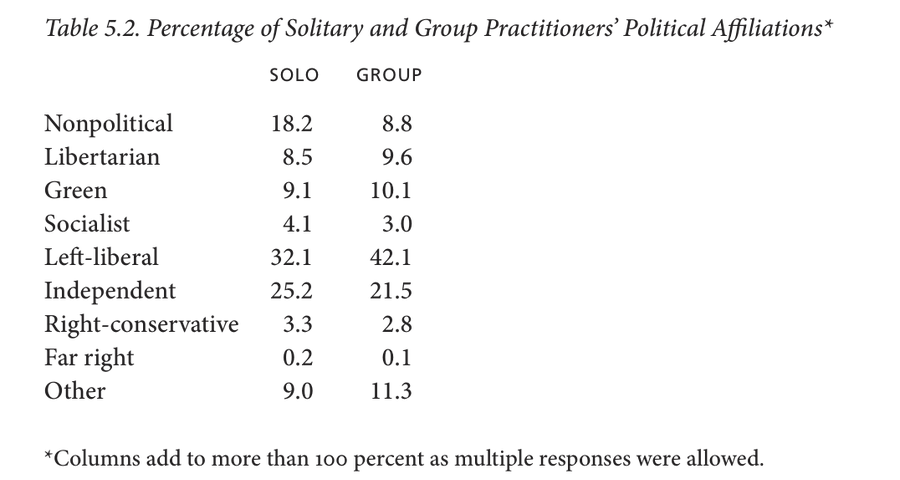
These are the figures from the religious movement that promises to stop communism and the race to the biological bottom? Breeding ever-grotesque and obese behemoths that end-up with hundred page books stuck in the folds of their fat while bemoaning the bullying and discrimination that the morbidly obese must deal with on the daily?
Yes, this is the salvation of the west! Please, Jaba the Hut, come down from your dais, set down your copy of Das Kapital, and resurrect the former majesty of the America!
The surveys skew left, but the data would have to be spectacularly inaccurate to deliver such high figures.
It is also not the only data point. Judging by the TikTok followers, X accounts, book sales, and other social media footprints, paganism is left-dominated movement, and it is most certainly not going to save the West--at least not in the way it's sloppily promoted.
The data also begs another question: how does the leftist streak in paganism square with the narrative that Europeans would have colonized the moon by now had it not been for the disruption by Christians?
I indulge in such fantasies myself, but we can never know how paganism would have run its course over the last 1,500 years since its ascendancy in Europe.
Leftism already was taking root in urban Rome under the stoics, who advocated for a nascent sense of human rights and cosmopolitanism—a force which contributed to Her collapse from genetic admixtures and exhaustion.
A timeline with a pagan West could have been far more destructive and dysgenic than what unfolded under during Christianity’s reign—evinced by how many blue-haired, tatted witches cheer on as 20-year-old Arab men march across Europe, draining government funds, raping young women, and tearing out the pillars of European civilization—all while sending fat checks back home.
A defense might be that that the salvific potential of paganism is actually just a by-product of folk vocabulary. What its proponents really mean is that a particular brand of paganism will save us. Rather than avoiding the issue, this fix thrusts them deeper into it.
First, if a pagan admits this, then they must also admit that their frequent punching bag—the Abrahamic frame—is not as uniquely corrosive as they have claimed. The worship of deformity, scleroticism, and decay can as surely assert itself outside of Christianity as it can within it.
Secondly, it casts into doubt the commonly-held hypothesis that what we’re experiencing today is an inevitable consequence of Abrahamism. The assumption is that Christianity possesses a DNA that, like a swallow flying to its ancestral mating grounds, inexorably results in trannies doing windmills before 7-year-olds and ethnic grievance politics.
Christianity, Judaism, and Islam have different characters and forms, and the results they produce, like with paganism, are in no way inevitable or baked into their DNA. Islam has not consistently produced a woke hellscape. Judaism has produced both a robust, militant right-wing that has wiped Gaza off the map and a rabid left wing that seeks to accelerate the abolition of racial and economic differences.
Modern forms of Christianity in the West possess this dual character. Evangelicals, for all their moral posturing, have many militant patriots that would shame a vast majority of our right-wing brethren.
While these religions do have centers of gravity that pull it in particular directions over time, they are engaged in the same struggle that pagans are today: between the forces that seek the rarefied air of mountain streams and peaks, the sting of the wind, the serenity of watching clouds form and pass over lesser valleys, the forces that yearn for the beautiful, the powerful, and the glorious against those that, like the worm or the cattle, seek what is closest to their noses, wallowing around in their own shit and the simplicity of unearned leisure. These latter forces gravitate towards the common, the fringe, the disturbed, and eagerly pass out golden stars to everyone for the simple fact of their existence.
Thirdly, if the categories of Christian and pagan fail to capture the range of their ideologies and how much common ground they actually have, then we must redraw the battle lines and rethink the current strategy.
White Christians are the largest and most resilient bulwark against leftism in American political life. Evangelical Christians vote to the right—with 81% backing Trump in 2024. White Catholics and Protestants also strongly backed Trump, at 60% & 57% respectively. Their brown co-coreligionists are far less eager supporters, reminding us of the fact that ethnic loyalties and cultural values often trump or at least temper religious ones.

The white Christian demographic controls vast swathes of the country, has access to deep coffers, both cultural and religious, and have the loyalty of a significant percentage of the security apparatus. This institutional capture is particularly true at its highest echelons.
Right-wing white Christian aesthetics, values, and beliefs have much more in common with right-wing pagans than most other demographics in modern America. This statement will trigger many pagans, slobbering at the mouth and ready to denounce it with quotes from the Bible or a lecture by Pope Francis to prove that we can find no common cause among their ranks. Their approach to religious cultures is, frankly, ridiculous and rabbinical.
Christians, like pagans themselves, are not mindless automatons following the orders of their betters. If this were so, the most explicitly Christian period in European history, the mid and late medieval periods, would be full of godly celibates of blemishless virtue. Instead, medieval men (and women) were a motley cast of characters whose virve, freedom, and love of violence would shock most of us today.
The division between the clergy and their parishioners today has grown considerably. Institutional trust is on the wane across the board, and that includes in religious institutions. The priestly class have insulated themselves from the concerns of their communicants in favor of an abstract “human race” and the phariseeism of their colleagues. They have taken an increasingly adversarial stance against nationalism and common-sense political positions in favor of an excessive, self-flagellating morality, divorced from the needs and concerns of the communities it is their responsibility to protect.
Lower-level priests and devotees have come to disdain this elite and hew their own path. The one exception to this has been the evangelical movement, which manages to maintain a hyper-nationalistic character while embracing some of the worst forms of schoolmarming, like claiming that listening to rock will and/or masturbation leads to Hell. The truly iconoclastic might attempt both to fast-track their journey to the inferno.
To understand what they actually believe, not what the books or priests say they should believe, or even what they outwardly confess themselves to believe, we have to look at their choices.
They, by-and-large conform to what right-wing pagans advocate themselves:
- The celebration of beauty, strength, and wealth
- Encouraging family formation & the family as a unit of resistance
- Protecting national interests against the predations of multi-national companies, third world beggars, and ideologues
- An unabashed patriotism & swaggering confidence
- Race-realism and its consequences
- A more traditional view of the sexes
- A taste for classically-inspired art
- A love of liberty & personal autonomy
- A sense of care for their own people
- The centrality of spirituality in the fortification and reviving of the people
- A comfort with war, violence, and the bloody realities of rule
- A disgust with transgenderism and the numerous mental illnesses disguised as identities
- A healthy respect for the appetites
- A willingness to pursue protectionist programs for their fellows
- Admiration of excellence & the determination behind it
I could go on, but these should suffice. Even the Christian sense of charity finds fellowship with many programs of the populist emperors, who saw themselves as defenders of the people, joining a worship of what is high with a healthy respect for the common man.
The two faiths hold conflicting metaphysics, but the Christian and pagan right—when viewed as specific, social realities rather than academic abstractions—are natural allies.
The response to this proposed fellowship is often derision. Earnest pagans, eyeing more extreme solutions, take one look at the Christian right’s track record of utter failure to conserve anything of value over the last century and toss it into the ocean. The Christian right has taken, again-and-again, L after L. Allying ourselves to such a block dooms us to an eternity of losing.
This criticism is somewhat correct—although I will address it more fully in a later essay, but that does not mean that we should repudiate them as allies. Milquetoast conservatives are the bread-and-butter of the movement and compose a vast majority of politically interested Christians, deeply committed to the liberal project of the West, with America as its spearhead. Very, very few on the Christian right look beyond this narrow horizon of ideology, but, again, this is not a great failure of Christianity. Even among pagans, the political imagination is extremely limited.
Also, politics is the art of tradeoffs. Working within the mainstream Christian right’s framework in the short-term will mean taking positions that we don’t ideologically agree upon but are politically expedient and necessary.
What’s the alternative?
If you’re political game-plan is to revive the Third Reich in New York, good luck. You will find almost no political allies and, much worse, will be a target for the state. If you gain sufficient prominence to move beyond being a farcical political sideshow used by the left to terrify normies into voting for them, a long prison sentence or much worse awaits you—and any hope to political relevance along with it.
A rar-right Christian-pagan coalition would hardly be enough to fill a hall in Buckeye, Missouri. Most of the attendees will be men with access to few resources, fewer allies, and a mass of enemies. A pagan-driven political revolution is a pipe dream that talking heads love to engage in because it riles up their viewers, drives engagement, and sounds cool, but there is no viable path forward in the short- or long-term future, barring a Napoleon of Alexander emerging from the garbage-laden streets of Pittsburgh.
Whatever political future or goals we envision, it must be done with the help of our natural allies: right-leaning Christians.
Pagans are hesitant to join hands with them because of the long-standing animosity between the two groups. Over 1,500 years of persecution at Christian hands does little to help. Nor does the chest-thumping and St. Boniface poasting.
While a few Christians key-board warrioring from their mom’s basement would love nothing more than to hang a pagan from their heels, much of this is online boastfulness by nerds with little will or political purchase. In the last 100 years, American Christians have murdered zero pagans on religious grounds. The same record cannot be said for right figures being assassinated by leftists.
Most Christians are political realists, and they know that the idea of enforcing Christianity on the masses is outside the realm of the possible. With a country occupied by millions of Hindus, Buddhists, atheists, Muslims, and other religious minorities, widespread persecution at the hands of a powerful Christian regime is unlikely.
The much greater risk is of communist takeover of institutions and the erasure of European culture and peoples. I would gladly live in a Christian monarchy and practice paganism in secret than under a Paki Maoist driving the economy into the ground, dishing out ethnic reprisals, and fattening the earth with shallow graves.
We must ally ourselves with Christians, and this recognition entails a rethink of popular strategies.
First, the attacks on Christianity as a whole must simmer down. They are not only frequently misplaced but inflame relations with a group that we should be marching shoulder-to-shoulder with.
Two caveats: 1) attacks on leftist Christianity are necessary but should avoid essentialist or overly-broad language and should eagerly place leftist pagans in the firing line; 2) defending yourself against Christian attacks is commendable (from whatever side)—if they punch first, punch back and punch harder.
Second, right-wing pagans should actively pursue fellowship with Christians. Right-wing Christians (as these are the ones, ironically, that are the most hysterical about the pagan revival) rarely target Buddhists, Hindus, or other religious minorities. Their restraint is not without reason. The priestly class has been thoroughly exposed to Hindu, Buddhist, and other religions. In many cases, Christian clergy have befriended Zen monks, Hindu yogis, and atheist researchers. These groups meet each other at inter-faith conventions and have been in continuous intercourse for well-over a century.
Paganism is a “new” religion on the scene, and it is wrongly thrown into the same bin as Satanism or New Age woo-woo like Wicca. The priestly elite and the everyday Christian are rightly suspicious of it, often with their interpretation of it filtered through the entrenched “pagan = evil” link preserved for over a thousand years. Prying that association away, introducing them to paganism’s actual beliefs, and establishing common ground will take time. A long time.
Another critical problem is the leftist domination of paganism, particularly in media. Christian priests have largely been exposed to the most repulsive and degraded forms of our religion. The ecclesiastical dismissal and scorn should be unsurprising when their point of reference is a polyamorous 20-something with armpit hair, a septum piercing, and a Taylor Swift tattoo on their neck teaching kids how to cast a love spell on TikTok using vaginal fluid and Costco-bought pig blood. These witches disgust them as much as they do us, and it is this dysgenic hag that appears before their mind’s eye when they hear the word “pagan”—not Alexander marching boldly through the Alborz Mountains to reach the Caspian Sea, Pindar’s luminous lyrics, or a Gaulic army towering up the bones of the enemies and singing hymns to the heavens and vultures.
More serious interactions between right-wing pagans and Christians typically centers on disputations, debates, and memes. The memes are doing us little service other than widening the gap of our little digital fiefdoms while the “kings” congratulate themselves on how utterly BASED they are whilst being as impotent as an 80-year-old. Worse, the memes are typically poorly targeted and play into the hands of our enemies.
Debate has its place, and shifting religious affiliation pulls political and social beliefs in different directions. I suspect that right-wing Christians who convert to right-wing pagans will become much more right-wing, but the jury is still out on that.
But the actual conversion potential of debates is rather small, appealing to the sliver of on-the-fencers, while riling up and dividing the more committed. Furthermore, debates typically focus on very esoteric religious issues, like the nature of god or the foundation of belief or whether elves really exist or authenticity in modernity.
Instead, pagans should have dialogues rather than debates. The latter is necessary for a robust intellectual culture and battle-tested ideas, but you don’t refine and sharpen your metaphysics while Somalis and Guatamalans flood and loot your nation. You fight.
Third, paganism has to grow past the “FUCK YOU MOM” 17-year-old contrarian attitude. Christianity, and every other religion that has implanted itself in hostile territory, has done so through adapting the prevailing culture and mythos to its own ends. When Buddhism stormed into Tibet, it did so under the auspices of not only bringing the Truth but also to pacify and repurpose the presiding demons there. Local spirits became allies and protectors of the dharma rather than ambivalent forces that menaced the locals. I’m more inclined to demons stirring up trouble in response to too much yak shagging, but Buddhism won this war.
Christianity pursued a similar strategy. Its earliest form took on the character of a mystery cult, echoing the Elusian Mysteries centered on Dionysus. As it moved from a fringe movement to a dominant, state-sponsored, imperial religion, it sloughed off its mystic, esoteric form. The Semitic rebirth cult adopted the public forms of the imperial religion, from the style of tonsures worn (based on the flamens) to singing hymns standing to a highly legalistic oragnizational structure.
As Christianity expanded into other lands, pagan gods were conflated with Christ or euhemerized as saints. Tara, the center of druids and kings in Ireland, was reimagined as the site of St. Patrick’s victory over false gods. The eternal flame of Brigit, likely a holdover from paganism, was put into the care of a nunnery, and ancient pilgrimage routes were given a Christian veneer.
Pagans would do well to do the same. The Viking Age aesthetic and barbarian ethos has a lot of cultural cache because it is taping into an animus and exhaustion with modernity’s claustrophobia and asphyxiation, but the accusation of pagans being LARPers is, in part, correct. There is something alien and off-putting to most, including influential men of finance, kingmakers, and generals, about long-haired, bearded men in tunics toasting “Skall!”
The instinctual cringiness of it is that it departs so markedly from the past. Rather than building on the layers of Christian history and culture, it attempts to dig hundreds of meters beneath the layers of taverns, factories, and boarding houses to reach a layer of culture unsullied by the cross. That layer, to their dismay, is rocky, dead, and incapable of supporting life. If they waited another twenty years, green tendrils might push through the film of loam and begin to establish itself.
The digging, the movement of massive amounts of dirt and debris, the desecration of historical sites and memory, and, finally, the long wait before the soil becomes fertile again—it begs the question: why? Why not just build upwards from where we are now?
If history is to guide us, it’s the only way up.
Instead of adopting the posture of an ungrateful sixteen-year-old, we should be grateful for and respectful of our parentage. Our paganism was born on Christian soil in a Christian country, whether we like it or not. The great accomplishments of the West in the last 1,500 years have been under the cross—as the influence of paganism waxed and waned. Rather than repudiating it as vehemently as possible, pagans should have a more charitable attitude towards our Christian heritage.
Thinkers like St. Augustine, John of Eriugena, and Kierkegard ought to be studied and spoken of with reverence rather than dismissal. Great Christian explorers and conquerors, like Robert Guiscard, Fernando Cortez, and Sir Francis Drake, should be given the same honors as Alexander, Lysander, or Theagenes of Thasos, among the greatest athletes to have graced the hills of Greece. The iconography, fashion, writing styles, architecture, vocabulary, organization structures, and rites of Christianity should be tastefully and carefully integrated into the pagan faith.
Extending the olive branch to right-wing Christians is not a sign of defeat. It is a recognition of our precarious political position and the fact that our attention should be squarely placed upon the most immediate and certain threat: communism & its bastard offspring.
In this struggle, left-wing pagans are our avowed enemies and should be treated as such, and the Christian right should count as among our closest of allies.
The relationship will be fraught with tension and friction, but politics is a messy business that rarely offers easy friendships. The question is not whether this is the ideal political coalition we which to form but whether it is the best option available.
At present, it is—without a shadow of a doubt.
And if we are to ally ourselves with the Christian right, we ought to do so with confidence, tact, sincerity, and respect for the values they champion and we share.
If we are to win, we must stand shoulder-to-shoulder with the followers of Christ against the long house, the old, the ugly, the biologically deficient, the bringers of ruin, the darkness.
If we wish to win, we must win together.