
The Aesthetics of Tragedy
The perfected, swaggering bronze of Hercules was degenerate. So too were the other wax-cast gods and heroes from Classical Greece—a puritan’s grab at unalloyed beauty that presaged their downfall. What has survived, however, is sublime and offers among the purest aesthetics available today.
The perfected, swaggering bronze of Hercules was degenerate.
So too were the other wax-cast gods and heroes from Classical Greece—a puritan’s grab at unalloyed beauty that presaged their downfall.
What has survived, however, is sublime and offers among the purest aesthetics available today.
But not for the reasons you’ve probably heard.
Allow me to explain.
First: the visual arts of Classical Greece were degenerate.
They were too perfect. The finely sculpted abs of Zeus, the articulated robes, gathered at the calves, of Aphrodite, and the perfect proportions of Poseidon overlooking the Aegean. These sculptures are monuments to artistic excellence but betray the excesses of the Classical period.
The ideal had replaced the natural—what should be had eclipsed what is—and what is, its deepest undercurrents, the eternal struggle of the divine suffusing, patterning, devouring, and vomiting out the universe moment-by-moment, is always more arresting and powerful than wish casting. It is also much more grotesque, vulgar, and varied than the idealistic would prefer.
Classical polish cloys, in much the same way as a Turkish sweet, saturated with sugar, is inedible—unless accompanied by a bitter cup of coffee. It is too much.
If the originals survived completely intact, this fact would be more obvious. Apollo Belvedere would not win the praise and attention as he does today. The statues would strike us as absurdly good, and we would, I suspect, intuit that something is amiss amidst these perfectly sculpted forms.
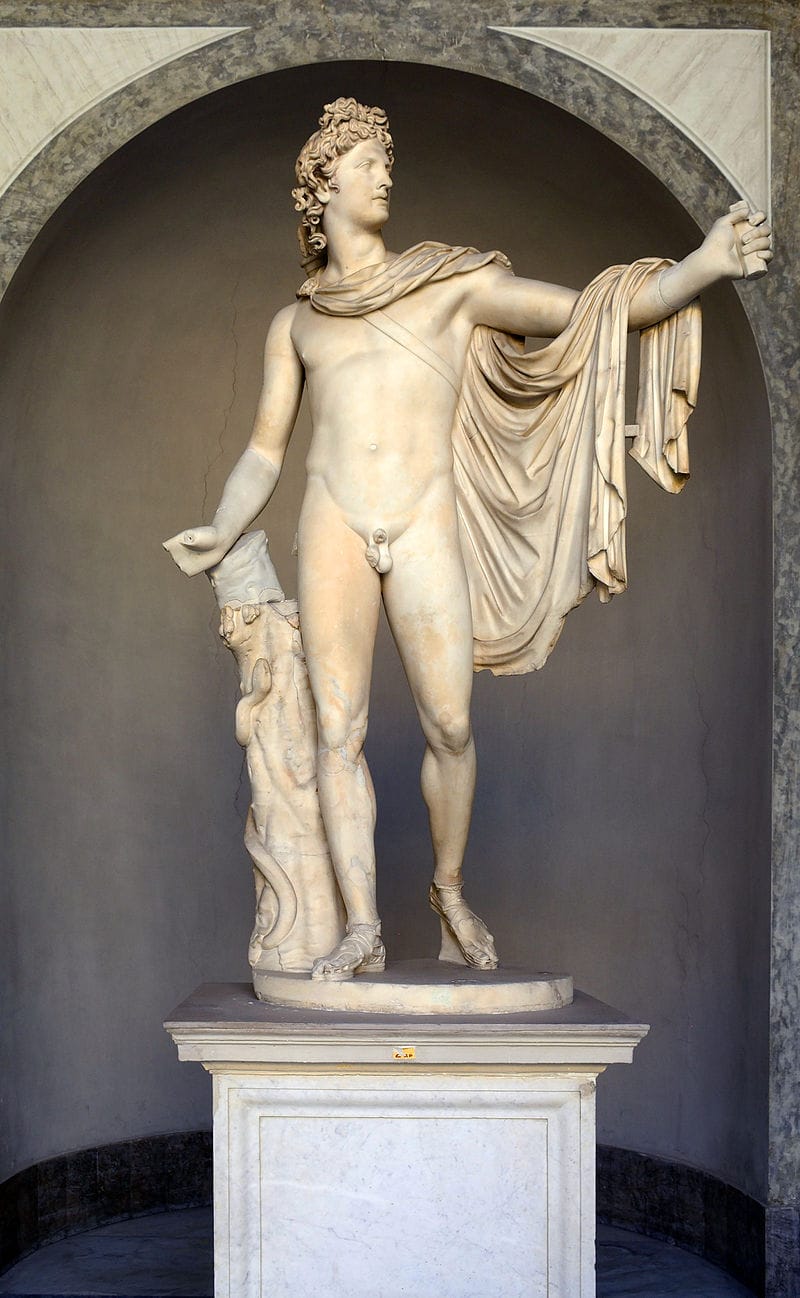
Those missing elements are contrast, tension, and a brooding darkness. The “God as War” of Heraclitus and Cormac McCarthy has been completely expunged in favor of “God as Harmony,” and in this, it repudiates the obvious facts of existence and the theophony of the gods.
The perfected form of Apollo Belvedere is, to put it bluntly, a boring, seductive distortion, like a Victoria Secret model with a stunning set of…legs, zero personality, and conversation range that rarely goes beyond “that’s pretty” and “I like that.” Even then, they might rile up some lust and make for good sport in the bedroom. The same cannot be said for a bronze statue of Aphrodite. It is as cold and lifeless as the bronze from which she was cast.
The Greeks well understood this fact. At the heart of Greek culture—from the gymnasium to the courts to the academy to the stage, the agon, the struggle, the competition, drove Greek greatness. Without it, life devolves, and embedded in that agonic ethos is tragedy.
Tragedy is the pre-condition of heroism. Heroism without the gnashing of teeth, without the letting of blood, without the sacrifice of the high for for the higher is no heroism at all. Such deeds commit the most abject of sins: being commonplace.
The highest form of tragedy—and one which afflicts all creation—is death, the realization that all our struggles, ambitions, efforts terminate in failure. We, mere mortals, cannot go on winning for ever. Madness, hubris, senility, or our betters eventually lay us low
Hercules slayed his own family in a fit of madness, and this horror compelled him to venture out and slay monsters, punish unrighteous kings, and ascend to godhood. Alexander’s conquest of Asia followed on brilliant victory after brilliant victory, culminating in his early and mysterious death. Achilles’ slaying of Hector, the greatest warrior of the Trojans, before the prince’s native walls was shortly followed by a femboy’s arrow to the heel sending him to Hades. Their tales are tinged with tragedy.
No greatness goes unblemished. This is evident in both Greek myth and history, and, as was the case with Hercules and Achilles, those very blemishes were the reason detre of their greatness. Even the gods (as Plato and later philosophers were scandalized by) suffered from a similar fate. They were lusty, tempestuous, murderous, and irreverent.
They were not good boys. They were not pristine paragons of beauty, as the marbled Apollo Belvedere was. They were rough, terrifying, and unpleasant presences that goaded history onwards.
Amidst the Greek obsession with beauty and harmony, they were acutely aware of the chaotic, the ugly, and the bitterness that, like a vein of granite in a piece of marble, ran through everything.
Yet the classical artists discarded this fact in favor of a grotesque exultation of beauty, expunging all hints of sorrow, tragedy, and terror from the luminous forms of a victorious general or an omnipotent Zeus.
This movement in the visual arts presaged Plato, Socrates, and the other puritanical movements among the Greeks as their civilization peetered out, a spent and exhausted people clinging to virtues that did not cause their former greatness nor could reverse their present decline.
It would be the rough barbarians, the Macedonians, that offered the hope of salvation—eventually squandered in an explosion of daring—not the effete Athenians disputing over the proper proportions for a statue of Athena.
The Macedonians were what Greek art should have been—wild, boisterous, extravagant, animalistic, vicious. But it was not to be—and the barbarians toppled them over and led the waning people on a final bid for greatness across Iran and into the hinterlands of Asia.
Great art, like the Macedonian armies marching across the Gedrosian Desert, should embody the contradictions and agonies of existence. It is not, as reactionaries often claim—in a knee-jerk response to the modern-day worship of the slovenly and malformed, solely dedicated to beauty.
Even if art were thrown before the altar of beauty to achieve the highest, unalloyed instantiation of it that human will and hands could muster, it would require the grotesque and the revolting, the barbaric, the dark, the violent, the horrifying. The contrast reveals the former, and that makes its taste all the sweeter, just as, after a bite of baklava, a sip of coffee brings out the sweetness a thousandfold.
Now we come to part two: what has survived is sublime and offers among the purest aesthetics available today.
The reason for this is simple: only fragments remain.
The Victorious Youth, one of my favorite Greek sculptures, was recovered off the coast of Italy by fishermen. Barnacles encased the original, while corrosion had devoured its feet. Conservators made an exhaustive effort to restore it to its former glory, but only so much can be done to a bronze statue that spent two thousand years in the Mediterranean.
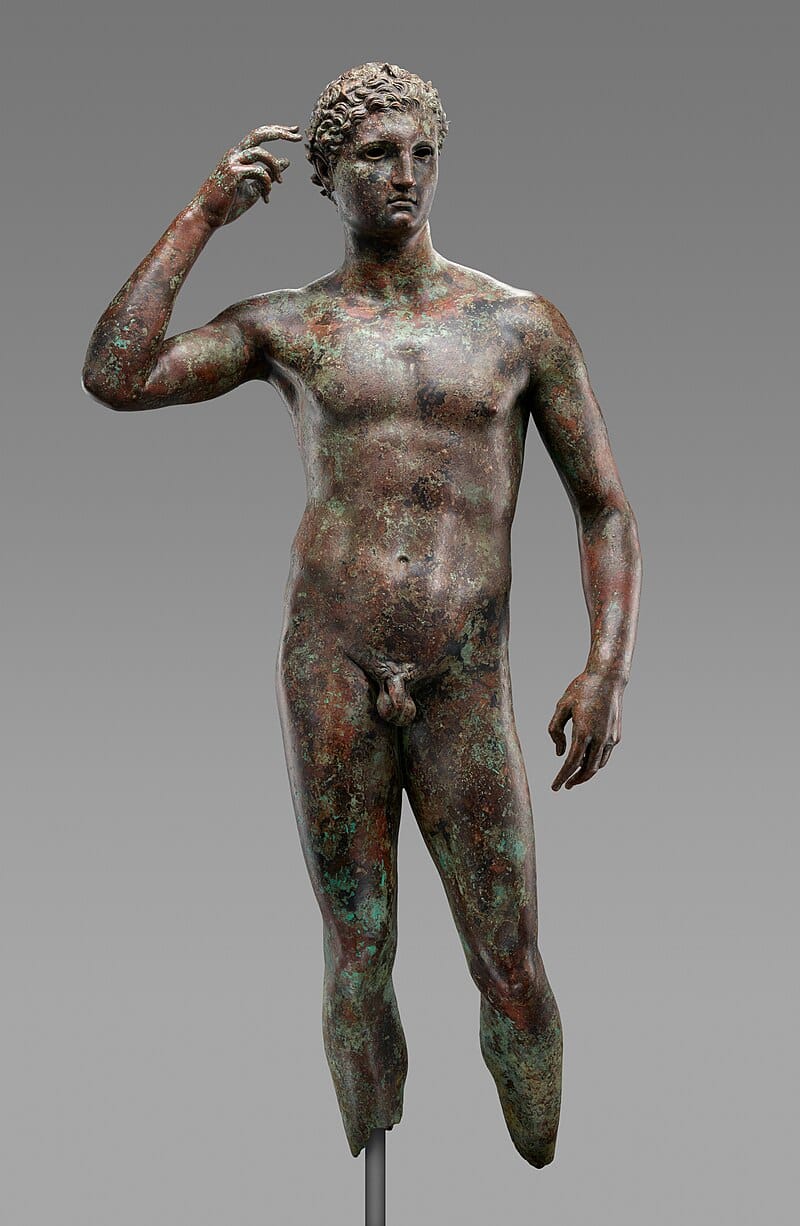
The statue’s skin is mottled, his crown missing, and his empty sockets gaze vacantly into space. He exists as a fragment, an artifact ravaged by time and forever beyond our grasp.
In this, the aesthetic is not one of unalloyed perfection, as the original artist strove for, but of a beauty tinged with loss, like a tea cup fractured and rejoined with pieces of gold or a Chinese landscape painting punctured with swathes of empty space. Destruction introduces tragedy.
The absence is pregnant with menace, nostalgia, grief, hope, and yearning. Its ruin reigns in the excesses of the Classical period and presents us with something that is far closer to what is than its creators could have hoped to achieve.
It is, like most great works of art, perfected (if I dare say it) by the cruelty and indifference of time and the vicissitudes of fortune.
The irony is that Classical Greece enjoyers have often attempted to replicate the imagined originals, like Michelangelo's David, in the hopes of reclaiming the grandeur of its former form, but David, for all of its technical precision and physical excellence, is flat and gaudy.
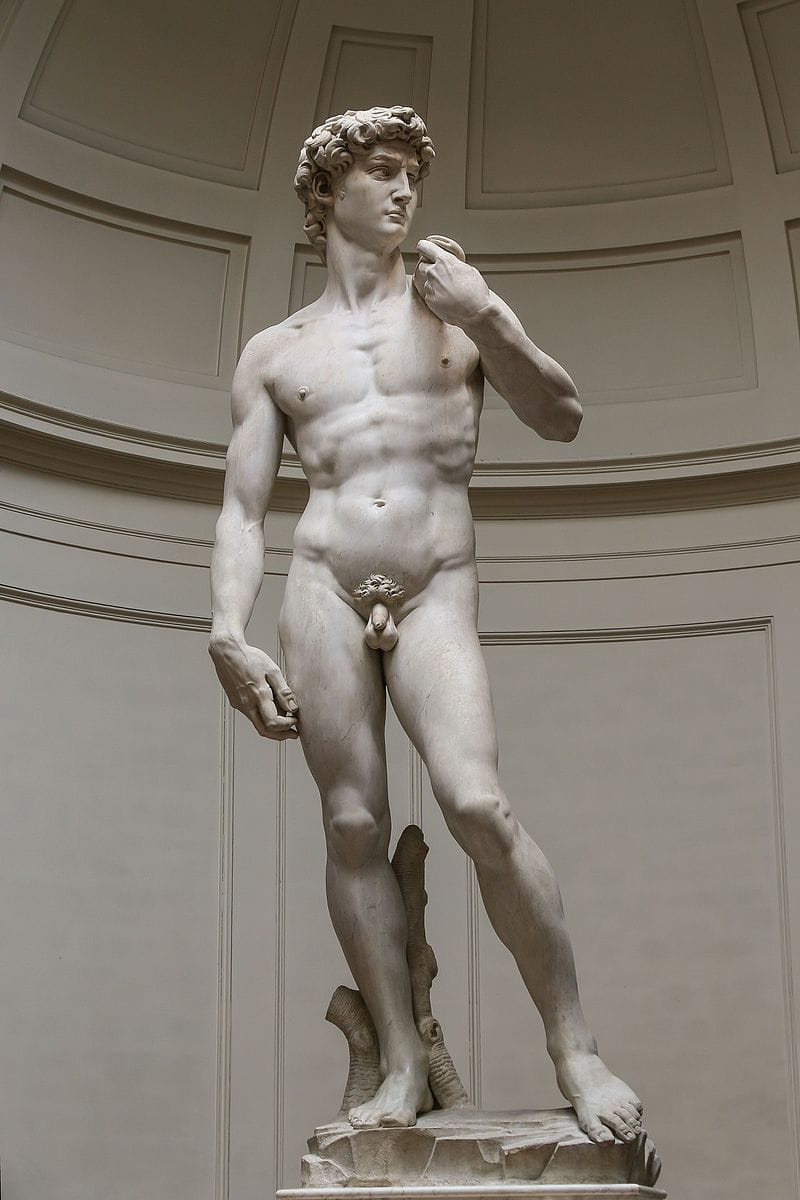
Fittingly, the head of David graces many-a-mid-wit meme and online reactionary account—boldly proclaiming to RESTORE BEAUTY and RETVRN, not knowing that they are worshiping the very forces of ruin that they claim to resist.
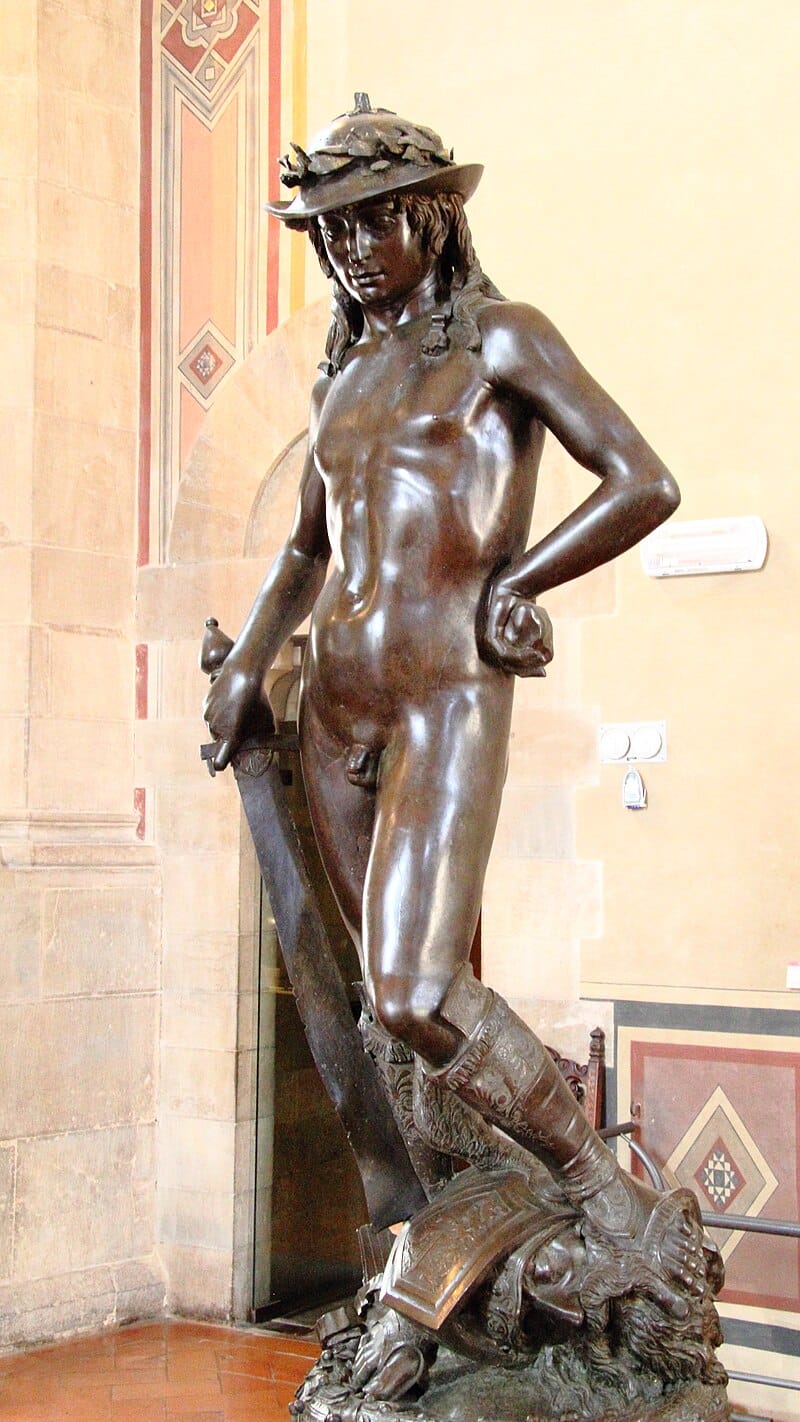
Donatello’s David is far more interesting. The sculpture captures the swagger and youthfulness of the unlikely hero, contrasting the martial exploits with his boyish body and gangly limbs. It wreaks of the awkwardness of pubescence and matches far better with both the themes and the pitch of the Biblical story.
A more vital, honest, and, ultimately, inspiring aesthetic is the ruined torso of a Hercules over the overwrought, intact David. The Herculean fragment simultaneously reminds us of what is: destruction, ruin, loss, yearning, sorrow, struggle—and invites us with its endless possibility of what could be: a statue more refined and beautiful than David or Apollo—that only the imagination could create.
Disintegration and fragmentation are not the only way to achieve this effect. The Chinese landscape painters incorporated the empty space of the canvas to elicit such a mood. The ancient Tantric sites of India mix the voluptuous form of Shakti with rough hewn stone smeared with sandalwood paste.
The way forward, though, is not to merely copy-paste the existing aesthetic. As an artifact, The Victorious Youth is divine, but artists should not be in the business of foisting archeological artifacts off as originals.
There is a word for such artists: frauds, and that is what the purely backwards looking artist is.
The youth died thousands of years ago. Let him rest!
It is time for us to take up the chisel, the brush, the pen and craft our own aesthetics, native to our own moment, our own confluence of cultures, concerns, anxieties, myths, and symbols. It must emerge from the sediment of the present, where the sun still shines, the wind still lashes, and deer can trample over branches and locusts can devour a year’s worth of work in an instant. It is here that the artist’s work must emerge—not 10 meters under the earth with pick axes, shovels, and brushes.
We can and should draw inspiration from the past—clearly conscious, as well, that it is not the complete original that is so compelling but its fragmented survivor.
But we must embrace new forms that uphold the archaic principle without mindlessly aping the form.
A people’s fate, as the Classical world and countless other examples have shown, is downstream of culture and the biological realities that it drives its members towards.
Let us choose not the cloying beauty of Apollo Belvedere.
Let us, instead, choose the rough, wild, and terrifying visage of the Macedonians, the swaggering David, and the tragic Victorious Youth hauled out from the Mediterranean.
Let us choose tragic beauty.