
What Does a Pagan-Christian Alliance Look Like?
A friend of mine (Sadnamadr) pushed back on my proposal for a Pagan-Christian alliance. Based on years of nasty experiences with online Christians, the prospect seemed impossible.
“What,” he challenged, “would an Pagan-Christian alliance look like?”
My answer: Donald Trump.
The Donald is by no means perfect. I dislike his coarseness, religious apathy, materialism, and his reactive economic policy. He is more of an opulent New York shopkeeper than a Caesar, but good is always relative.
In this fetid political climate, he is the greatest political force and promises to overturn decades of stagnation and self-ruin under the guise of JUST BEING A DECENT HUMAN BEING.
For all that he’s done in his second term, right-wing Pagans (aka the Wolves) and Christians (aka the Crusaders) should sanctify him immediately. Throw up marble statues in every major city, drape his image along the highway, sacrifice extravagantly to the gods in thanks, and arrange a series of athletic games and feasts in his honor, for he is worthy.
He has been a flop in many ways and bungled easy wins, but his greatest accomplishment has been to break through decades of morass and throw open the windows and doorways to the ideological political prison of Westerners. He has sloughed off a century of guilt, the self-defeating moralisms, and the abdication to nefarious actors that are sucking America dry. As many have assessed, Trump is the vehicle not the end.
Whatever the future holds (and it looks extremely bleak for Trump once the Democrats return to power), the New York mogul has surpassed all expectations and united a fractious right—including the Wolves & Crusaders.
When political stakes are high, these two enemies (on paper) have cast aside their differences and rallied around one of the few men fighting for their values. They have, in other words, allied themselves.
Forming a political alliance does not require Sunday brunches, inter-faith conferences at Harvard, or camping trips along the Pacific Crest Trail. It can—and, honestly, more fellowship between the two would do much good—but it need not be so cordial.
With Trump, all Pagan and Christian supporters had to do was throw themselves behind his political machine in whatever way possible—be it boots-on-the-ground campaigning, donations, or Pepe memes—to get the orange haired devil back into the White House.
The Pagan-Christian alliance already exists, and it has existed for decades despite all of the posturing and denunciations from both sides.
Many other political battles follow this pattern. Immigration. Education. Foreign policy. Government spending. In a vast majority of cases, the Crusaders and Wolves are in alignment and working towards shared goals. Outside of formal organizations, these efforts are siloed among poasters and their communities, but within political organizations, like think tanks, lobby groups, and community programs, the two work side-by-side, ignorant or indifferent to the religious beliefs of the person at their side.
The natural means to an alliance is to focus on concrete, shared ends and collaborate to make them a reality while avoiding explicitly religious posturing and symbolism, like the election of Trump, securing animal rights, or stopping China’s pollution and depletion of the oceans.
I know this from personal experience. I have worked in and run political organizations. In these settings, I rarely disclose my religious beliefs or political allegiances nor have do I inquire into others’. Many who join would, on paper, detest my philosophy (or, at least, their TikTok understanding of what it is), but by avoiding these sloppy categories and the mouse-traps they set-off, that obstacle is easily sidestepped.
A colleague and friend of mine holds to old-school hippy politics. She’s a fanatical environmentalist, feminist, and granola communist. It doesn’t matter much to me or the organization. She’s pleasant, entertaining, intelligent, hard-working, reliable, and delivers every time she shows up. I want her on my team, and getting tangled up in disputes over whether the matriarchy is going to save the environment and precipitate the Age of Aquarias creates needless division. So long as she keeps her views in check, I am happy to have her along.
Concrete political action cuts through the abstractions and noise around belief, and action should be the fundamental orientation of Wolves—not online flame wars over whether Paganism or Christianity is a truly a salvific force for the West.
Islam & Christianity did not win based on the strength of their arguments but through their power as political, military, & ethnic forces. Initially, genuine religious sentiment and the strength of ideas was critical, but as it expanded beyond a marginal religious sect, more worldly conditions measured their success.
The map of the Islamic Conquest demonstrates this.
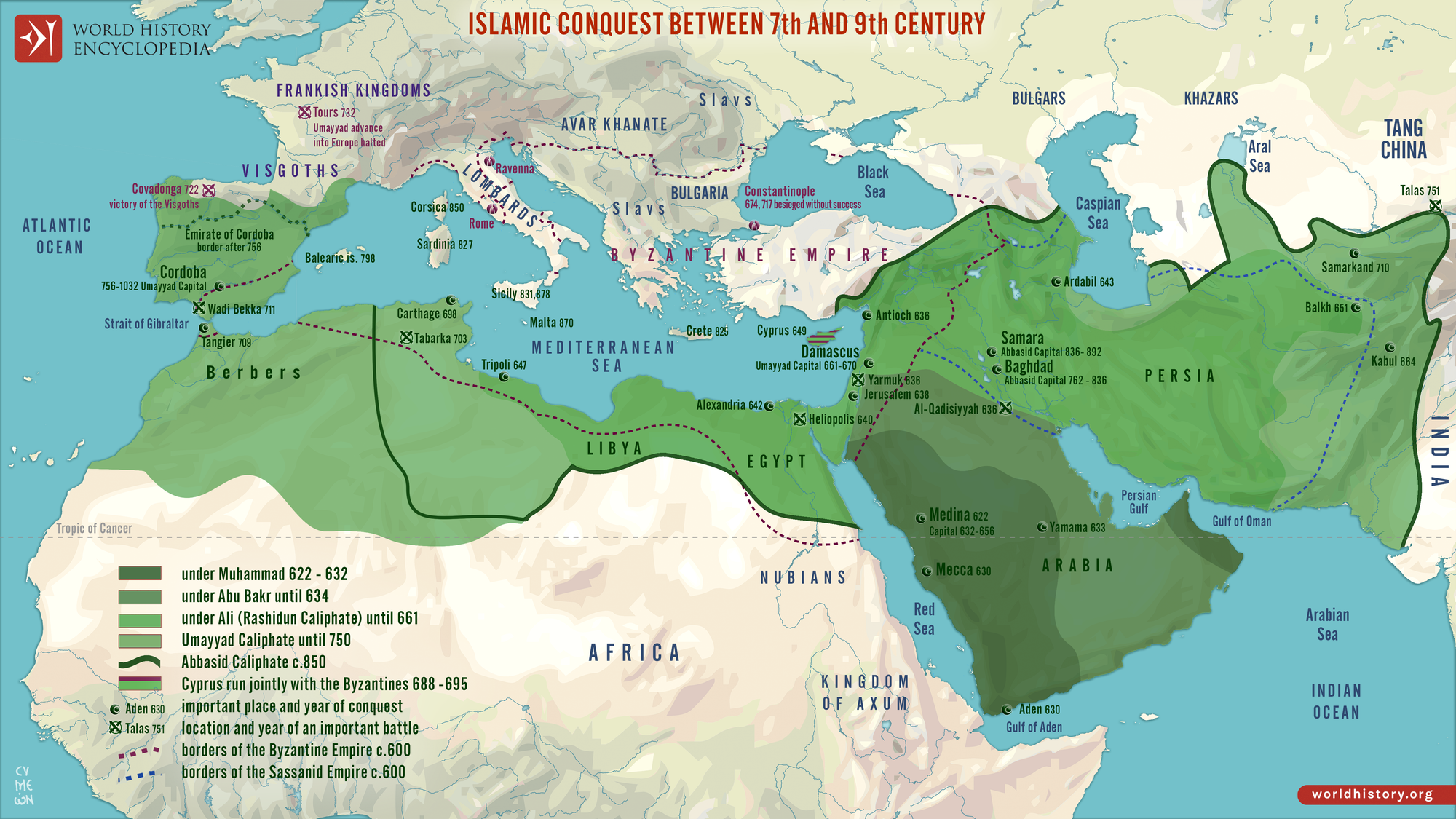
The conquest tracks almost perfectly with the distribution of Arabic DNA and the spread of Islam. If religions worked as the pundits, academics, and clerics argued, Islam’s spread would have happened independent of conquest, yet history proves otherwise.
Christianity repeats the pattern, rapidly spreading across after centuries incubating in Europe (where, often times, kings converted for political gain or admiration for the ardor of its adherents rather than on the strength of arguments). During the Age of Exploration, soldiers, merchants, and explorers eviscerated local religious customs and firmly planted the cross in Africa, the Orient, and the New World.
If we want to win, we must win concretely. Gain political clout. Infiltrate the security apparatus. Set extraordinary examples. Found revolutionary companies. Fatten our coffers. Seize control of a state. These victories result in real, lasting Pagan gains and a reshaping of the ideological landscape. Winning on the cultural and intellectual fronts is has its uses, particularly in the early stages, but ink is less persuasive and enduring than gold, iron, and glory.
To achieve these concrete ends, we must join hands with the Crusaders. While we punch above our weight culturally, we can hardly fill-up a convention hall let alone muster troops, direct billions in assets, and pull the political strings needed to advocate for our aims.
There are two elements to this: secular politics & explicit coordination with the Christian right.
Secular politics has become a loaded word, with many on the right conflating it with a grinning, fedora-wearing atheism. Secularism and atheism are not the same. Secularism is the avoidance of explicit religious endorsement, imagery, and language. Trump is a secular president. Improving the reading level of students in South Dakota is a secular political project. Secularism avoids much of the factionalism and, quite frankly, stupidity that comes when religions enter the fray. Secularism is not the end but, given the political situation, is the best alternative today.
The second element is the one that requires much more development: coordination with the Christian right. The siloing of information, knowledge, skills, manpower, and other resources leads to inefficiencies in any organization. The current antagonism between the two camps, thus, is hindering our efforts to better collaborate and target our attacks. As Napoleon (and every other commander worth his salt) always said, “Never split your forces.” The way to victory is through the tip of the spear: massing all your resources into a single point, direct it at the weakest element, and let loose.
These resources would best be served by funneling them through secular organizations, but as long as Crusaders & Wolves organize themselves, consider, and act along political lines, then channels of communication should be open between them to better direct said efforts.
This alliance is not without risk. The Wolves and the Crusaders have political & religious differences with consequences. The Crusaders are much more compromised and corrupt than Pagans by dint of being closer to the centers of power. The recent leaks of naughty texts by the Young Republicans is just one of countless examples of this fact. Also, an ascendant Christian right might be far more hostile to Pagans.
Politics, though, is a game of trade-offs. The question is not: are there risks? But: how do those risks compare to other viable options?
In my estimation, there are none. Our only viable path to power is through the fanatical pursuit of concrete political goals, allied with right-wing Christians.
Such an alliance need not entail sitting around the campfire singing songs and raising toasts to each other. Rather, it must entail the ruthless, determined, and calculated pursuit of shared goals and the development of networks to collaborate and concentrate forces.
As much as we might hate to admit it, our short-term political future depends on the most unlikely of fellowships between Wolves and Crusaders.